
San Fernando City Directories on the Shelf
The best starting point is a coverage table, because a San Fernando volume can refer to a regional book, a telephone volume, a digitized title, or a microfilm run. The years below are verified collection spans or exact holdings. They do not promise that every annual edition includes the incorporated city.
| Collection | Verified years | Where held | Access and relevance |
|---|---|---|---|
| Los Angeles-area city and street-address directories | 1875-1987 collection span | LAPL Visual Collections | Free digitized browse and search; check each edition for San Fernando coverage |
| San Fernando telephone directories | Dec. 1937-Aug. 1948; Mar. 1967; May 1980; May 1984; May 1985; May 1987-Apr. 1988 | Library of Congress | Free image and OCR services; exact local holdings are non-continuous |
| Los Angeles city directories | 1873-1942 | LAPL Central History & Genealogy | Paper and film in the library; Valley coverage varies by year |
| U.S. city-directory microfilm | 1861-1960 | LAPL Central | In-library research across more than 5,000 rolls |
| San Fernando Valley directory | Cataloged title; year must be read from the item image | FamilySearch film 1035703, item 6; DGS 7954702 | Private citizens, firms, and rural residents across named Valley communities |
| California Death and Marriage Indexes | Death 1905-1994; marriage 1949-1986 | LAPL genealogy resources | In-library or database access; useful as companion evidence |
Coverage is a research fact, not a guess from a search box. The LAPL digitized directory collection is the broadest online doorway, while the exact San Fernando telephone items and cataloged Valley volume supply more local anchors.
San Fernando Directories from 1875 to 1987
The digitized regional run is the key numerical fact in the San Fernando historical directory search. LAPL describes Los Angeles-area city and street-address directories from 1875 through 1987. “Los Angeles-area” matters. An edition can be broad enough to include Valley communities, yet its metadata may not guarantee that every San Fernando street appears. Open the title and read its stated coverage before drawing a conclusion from a missing name.
The Library of Congress provides a more exact local check. Its U.S. Telephone Directory Collection records a December 1937-August 1948 San Fernando item and later Northwestern Section editions for 1967, 1980, 1984, 1985, and 1987-1988. These are free image and OCR records. OCR is a finding aid, not the final reading: columns, initials, broken type, and abbreviations can mislead a name search.
The 1937-1948 San Fernando telephone-directory record is a useful first edition anchor. The later exact items should be opened separately rather than described as a continuous annual run.
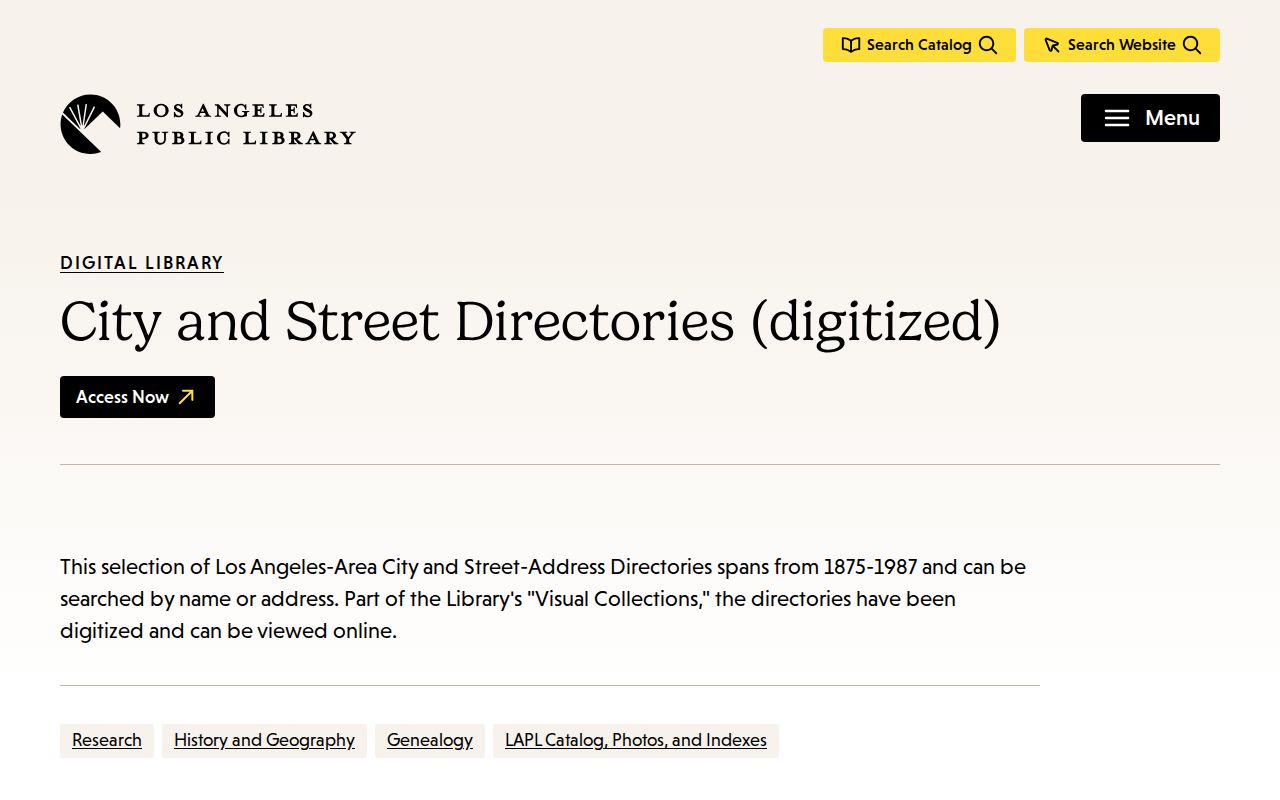
The digitized collection view shows why edition-level checking is essential. A broad regional span still needs a local coverage check for the street or surname under study.
The Valley Directory That Names San Fernando
FamilySearch catalogs a Los Angeles Directory Co. San Fernando Valley directory that explicitly includes business firms, private citizens, and rural residents of Burbank, Van Nuys, North Hollywood, San Fernando, Owensmouth, Chatsworth, North Los Angeles, Pacoima, Reseda, Roscoe, and Sepulveda. That list makes the title valuable for local history, but it also warns against treating “San Fernando Valley” as the same jurisdiction as the incorporated city.
The catalog record identifies film 1035703, item 6, and DGS 7954702. The exact publication year must be read from the item image. Account or affiliate restrictions may apply. Preserve the catalog wording, the title page, and the page number. A catalog description tells where the volume belongs; an entry scan tells what a particular page actually says.
The FamilySearch catalog entry supplies the specific local title. It is a distinct source from LAPL's regional digital run and should be cited that way.
San Fernando Directory Coverage by Volume
A San Fernando city directory result needs three checks: the edition's date, the geography named in its title or description, and the section in which the entry appears. A regional alphabetical list may include a Valley name without marking the city line. A street-address volume may use an older street form. A telephone book may show a listed subscriber but no complete household.
Local history can bridge those boundaries. The San Fernando Library opened in 1914, moved through North Maclay storefronts and First Street, and reached the civic center in 1953. The branch can refer a researcher to vertical files, local ephemera, yearbooks, telephone books, or the Valley history digital collection, even when LAPL Central holds the main directory shelf. Library circulation and account records are confidential and are not a directory source.
Search the San Fernando Library reference page for the branch contact and local-history path. Use a library referral to find a collection, not to infer a patron's presence.
Reading San Fernando City Directory Entries
A directory entry is a compact record with a publication date and a defined field set. The verified telephone-directory material supports a surname, given name or initial, street address, and telephone number. A city directory may use broader conventions such as an occupation, spouse notation, owner mark, or a street-order section, but those details must be verified in the actual volume. The research capture did not confirm one sensitive sample page for every field.
| Name | Surname plus given name or initial, as printed. Test accents, compound surnames, and OCR variants. |
|---|---|
| Address | House number and street form tied to the edition; compare with period maps or a neighboring year. |
| Telephone | Listed number or subscriber field in telephone volumes; it does not identify every person at the address. |
| Occupation or spouse | May appear in a volume, but the exact convention is volume-specific and must be read from the scan. |
| Owner or renter mark | Possible in some runs; do not assign a symbol's meaning until the edition key or local instructions confirm it. |
- Criss-cross directory
- A street or address-order section that lets a researcher move from place to listed name.
- Householder index
- A name or household finding aid whose coverage and field definitions depend on the volume.
- Abbreviation key
- The edition's guide to short forms, symbols, and marks; read it before expanding an entry.
- OCR
- Machine-read text from a scan. It speeds discovery but cannot replace a visual check of the page.
The correct reading keeps the printed fact and the interpretation apart. “Listed at an address in May 1984” is stronger and safer than “lived there continuously.”
San Fernando Name or Street Section
Forward and reverse searches answer different questions. The alphabetical name section is useful when a surname is known and may add a listed address, number, or occupation. The street-address section is useful when the house is known and may reveal a listed name for that edition. A telephone white-page entry usually supports only the fields printed in that book. A volume's additional conventions need a visual check.
Start with the address when a former house is the fixed point. Search the street form, test nearby spellings, and note whether the entry belongs to a business, a rural route, or an incorporated-city section. Then use the name section to compare a spouse, initial, or occupation. If the address appears in one year and not the next, test the edition boundary, an unlisted number, a changed street form, and a nearby regional title before calling it a move.
LAPL's ResCarta browse interface is the practical place to inspect digitized titles and move between image and OCR views.
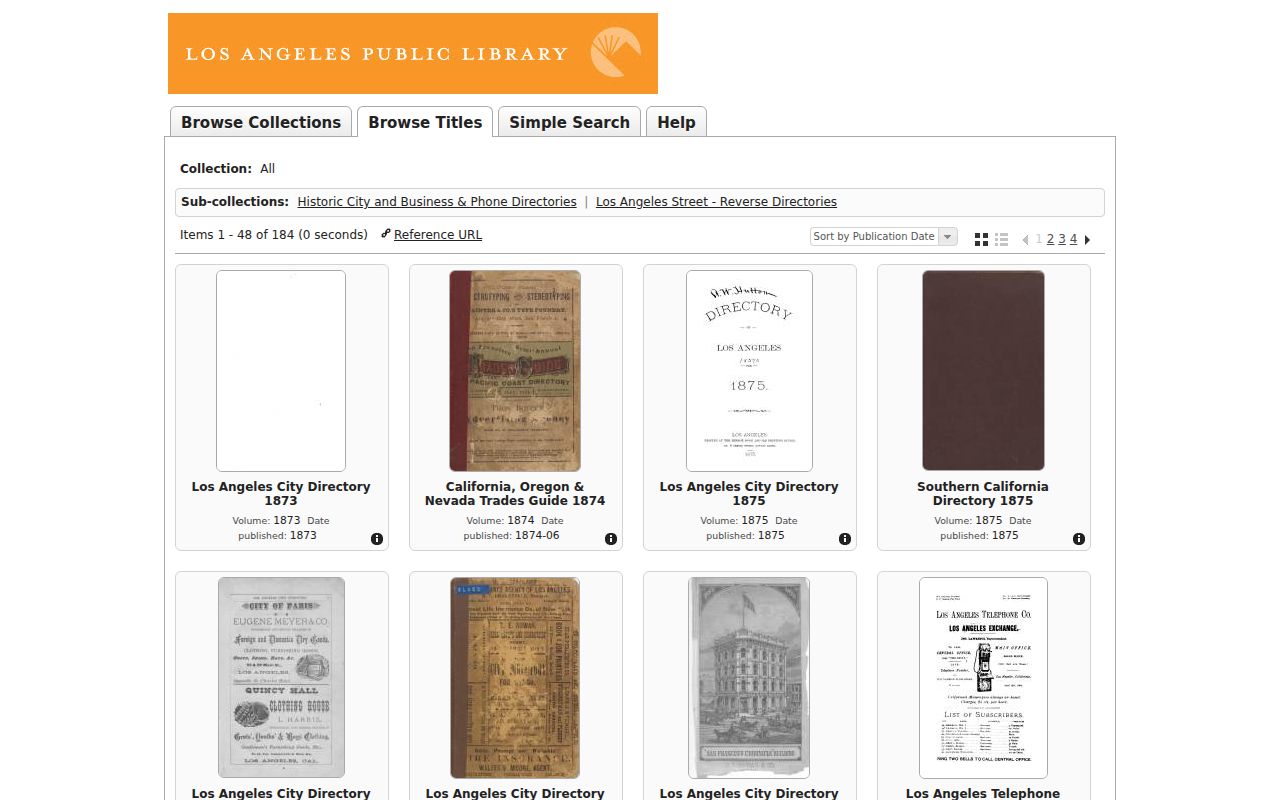
The browse screen is a tool for locating the right title and page. The scan, not the search snippet, is the evidence to preserve.
Trace San Fernando Directory Households
Repeated editions can bracket an arrival or departure without pretending to provide a complete life story. Use a known address, search the street section, then capture the name and any printed fields. Repeat the same process in adjacent years. Compare street spelling, initials, listed number, business name, and nearby households. A result becomes stronger when the address and identifying details hold across independent editions.
- Confirm the historical city or Valley boundary for the year and normalize the street name without erasing the printed form.
- Search the street-address or reverse section, if available, and save the scan title, edition date, page, and exact entry.
- Move to the alphabetical section to test surname variants, initials, spouse notation, or any occupation printed in that volume.
- Repeat in the nearest earlier and later editions, marking a first and last observed listing rather than claiming an exact move date.
- Pair 1900-1950 observations with released federal census schedules, then use deeds, probate, newspapers, or obituaries to resolve a gap.
The 1950 census is the latest released federal census under the 72-year rule. Census household composition and directory listings are complementary, not interchangeable. The National Archives census route and LAPL microfilm can supply a second historical source when the directory shelf is thin.
Trace San Fernando Directory Families
Family history benefits from the directory's ordinary details. A listed street can connect a relative to a neighborhood. An occupation can point toward a packing house, railroad, school, or business record. A spouse or initial can separate two people with the same name. These are leads for genealogy, not proof of a current address. Keep the printed wording and the record date beside every conclusion.
LAPL's History & Genealogy Department reports about 52,000 genealogy titles, more than 5,000 rolls of U.S. city-directory microfilm covering 1861-1960, microfiche for earlier years, about 1,000 hard-copy directories, and Los Angeles city directories in paper and film for 1873-1942. It also maintains census microfilm, California Death Index coverage for 1905-1994, California Marriage Index coverage for 1949-1986, and Digital Sanborn Maps with an 1867-1970 database span for library-card users.
The LAPL genealogy guide describes the library's microfilm, index, map, and local-history resources. For modern address-keyed records, switch to the San Fernando street directory workflow instead of rebuilding a historical shelf search.
The genealogy guide puts directories beside census, death, marriage, and Sanborn resources. That companion stack is often what turns one old listing into a careful family-history lead.
San Fernando Directory Gaps Need Sources
A missing San Fernando city directory entry has several ordinary explanations: the publisher skipped a year, the title covered a different geography, the telephone was unlisted, the household member was not the subscriber, the name was indexed under another form, or OCR failed. Search the image, not only the OCR, and check the title's coverage statement before treating a blank as a historical fact.
Companion sources supply different kinds of evidence. Deeds and recorder indexes follow title parties. The California Death Index can give a death lead. Census schedules show the household at enumeration time. Newspapers can carry notices and business context. Sanborn maps can show a building footprint and street continuity. The San Fernando Valley History Digital Library, CSUN collections, and the local library can add photographs, manuscripts, oral histories, and ephemera, with each item attributed to its own source.
| Collection landmark | 1875-1987 LAPL regional digitized run; check the individual edition. |
|---|---|
| Local telephone anchors | 1937-1948 bound range item plus isolated 1967, 1980, 1984, 1985, and 1987-1988 editions. |
| Historical household check | Released federal census schedules through 1950, paired with the directory year rather than substituted for it. |
| Building continuity | Digital Sanborn database span 1867-1970; select the actual San Fernando sheet and year. |
The result is a source trail with a stated gap, not a filled-in story. A San Fernando city directory is most useful when its edition, geography, page, and limits remain visible.