
San Fernando Previous Residents by Era
Each record family answers a different part of a previous-residents search. The current Assessor map establishes the parcel. Los Angeles County Registrar-Recorder/County Clerk records carry title work back to 1851, but the index is searched in person. Directories identify listed occupants or businesses, census schedules show historical households, and maps can explain a changed building or street form. The coverage table keeps those roles distinct.
| Source | Years It Covers | Where Held | What It Shows |
|---|---|---|---|
| Assessor and parcel maps | Current roll; older fields vary | LA County Assessor and Assessor Map | AIN, situs, legal geography, parcel facts |
| RR/CC recorded documents | 1851 to present | Norwalk RR/CC | Grantor, grantee, recording date, document, legal description |
| Los Angeles-area directories | 1875 to 1987 collection span | LAPL Visual Collections | Names and street-address entries by edition |
| San Fernando telephone directories | 1937 to 1948 range; 1967, 1980, 1984, 1985, and 1987 to 1988 editions | Library of Congress and related item records | Listed subscriber, address, and telephone details |
| Federal census | Released schedules through 1950 | National Archives | Household composition at enumeration address |
| California Death Index | 1905 to 1994 | LAPL History and Genealogy | Death lead for a former owner or occupant |
| Digital Sanborn Maps | 1867 to 1970 database span | LAPL subscription collection | Building footprint, use, and street continuity |
Coverage is not the same as continuity. LAPL's range includes editions whose San Fernando coverage varies. The Library of Congress holdings are a verified, non-continuous set rather than proof of an annual run. A missing year is a research gap to explain, not evidence that a person was absent.
1851 to Today in San Fernando Records
Los Angeles County formed in 1850, and the RR/CC viewing page states real-estate records and indexes from 1851. San Fernando itself began as a rail-era settlement in 1874 and incorporated in 1911. A pre-1911 address therefore has no city-clerk trail in the modern sense. County recordings, directories, church or mission registers, newspapers, and federal censuses do the earlier work.
RR/CC does not provide an unrestricted remote name index. The recorder's records are indexed by grantor, grantee, and recording year, not by address or APN. That makes the current parcel and its legal description essential starting keys. The recorder's in-person route is the way to search an older owner name, inspect the document number, and then request the instrument.
Copies can be ordered through the recorded-document request channel, with remote, mail, or in-person choices documented by RR/CC. A copy request is different from the index search. The search identifies a candidate instrument; the recorded image or certified copy supplies the text that must be read.
Note: The 1851 starting point marks county record coverage, not the date a particular San Fernando parcel or street first existed.
San Fernando Parcel Records First
The most useful insider tip for previous residents is to begin with the parcel, not a guessed name. Enter a normalized street address or a hyphenated Assessor Identification Number into the county property search. A public parcel card can show the AIN, situs, tract and lot or map reference, tax-rate area, property type, values, roll year, building characteristics, and transfer information when displayed. It does not display owner names or private mailing addresses online.
The ten-digit AIN is displayed as a four-digit map book, three-digit page, and three-digit parcel, such as 1234-567-890. The parcel key is more stable than a street spelling. Use it with the legal description, event document number, and recording date when moving into the deed chain. Assessor parcel details are versioned and generally update weekly outside the annual roll and tax-extension interval.
Ownership information can be pursued through a free district-office response or a specific-property inquiry using the AIN and full address. A mailing-address difference can suggest an absentee or entity owner, but it never proves where a titled person sleeps. The parcel proves an assessment attached to a location, not who occupied it.
Following San Fernando Deed Records
Once the current parcel and a recent transfer reference are known, trace the title record backward. Keep recording date and instrument date separate if both appear. Preserve every document number, party role, legal description, and unresolved conflict in a research log.
- Confirm the exact San Fernando parcel, AIN, situs, and legal description in the Assessor or map viewer.
- Use the current owner or transfer event as a lead and request the acquisition deed from RR/CC.
- Read grantor, grantee, recording date, document number, legal description, and return or mailing information.
- Search the seller backward as a prior grantee in the in-person recorder index, then repeat the loop.
- Carry the legal description because street names, unit labels, and numbering can change across decades.
- Bridge title parties to occupants with directories, census schedules, permits, obituaries, and probate evidence.
- Grantor and grantee
- The grantor conveys an interest; the grantee receives it. The roles do not describe every occupant or every person named in a filing.
- Chain of title
- The linked sequence of recorded transfers used to follow title parties backward through time.
- Legal description
- The tract, lot, block, or other parcel description that can preserve continuity when an address changes.
- AIN
- The county Assessor Identification Number used to connect a parcel map, assessment event, and later deed request.
A reassessment row is a lead, not a full deed abstract. Documentary-transfer-tax figures can be absent or misleading for gifts, trusts, partial interests, and exempt transfers. Do not call a transaction a market sale unless the recorded instrument supports that description.
San Fernando Records: Norwalk Fees
In-person recorder research takes place in Norwalk. The lower level covers 1851 through 1957, and the second floor covers 1958 to the present. RR/CC does not search by telephone or by address or APN. Bring names and variants, a year range, the AIN, legal description, known document numbers, and a list of years already checked.
Search the acquisition-year range under the current owner or grantee, record every plausible document number, type, and date, inspect the deed, and then search the prior grantor as a grantee. Staff can explain index conventions, but a middle name, trust, or entity may be filed differently than expected. Budget the disclosed $0.50 per name per year search fee and copy-page fees. Terminal and photography rules should be confirmed at the counter.
When travel is impractical, use RR/CC's recorded-document request process for a copy after the instrument number is known. Remote, mail, and in-person copy channels do not remove the need for the in-person name and year index search. The sequence prevents repeated broad searches and makes the previous-residents trail reproducible.
For an earlier gap, County Archives, FamilySearch catalog material, libraries, and LAPL can supply related records. None should be used to declare a deed missing until the correct year range, party role, spelling, and legal description have been tested.
San Fernando Deed Records: Title
The Los Angeles County real-estate viewing instructions are the manifest source for the recorded-document image below. Read the deed as a title document, not as a household list.
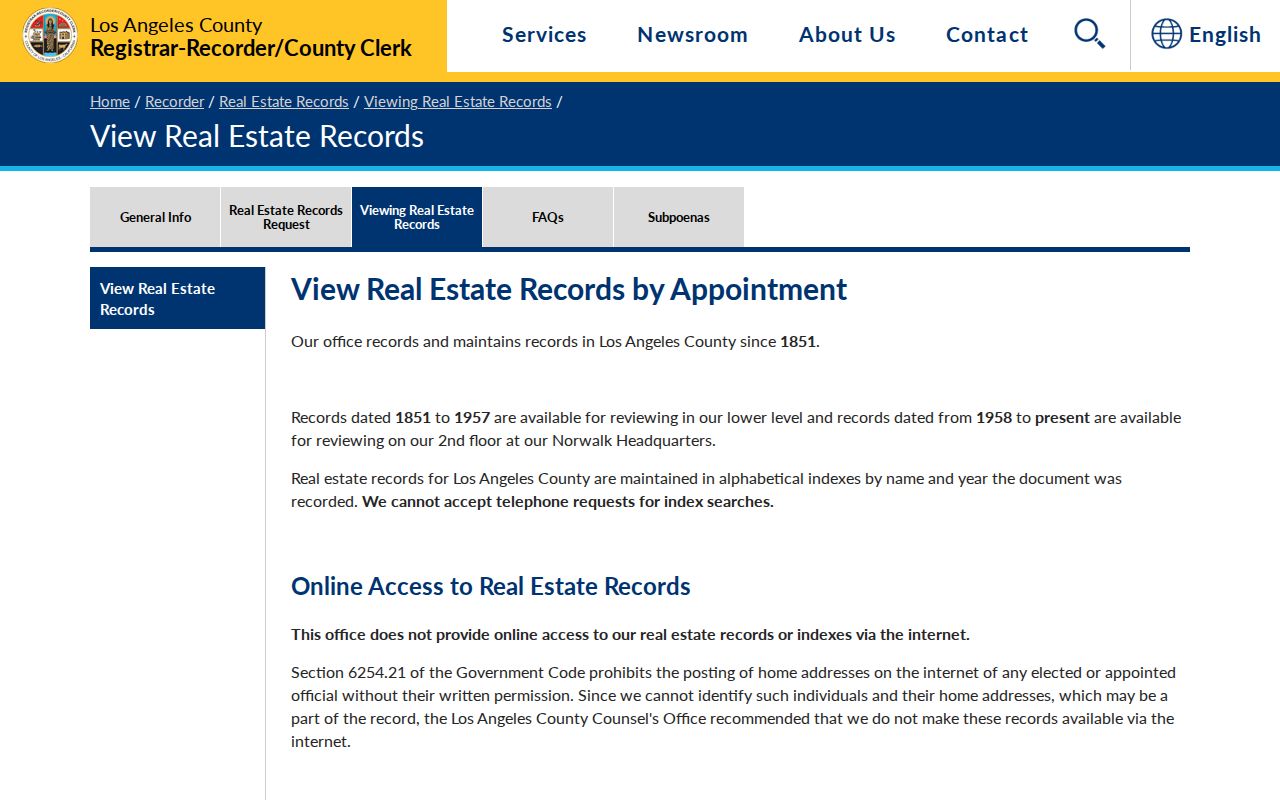
A recorded instrument can show grantor, grantee, document number, recording date, legal description, and return or mailing data. It may also contain a transfer that reflects a gift, trust, partial interest, or other event rather than a simple move. The image helps identify the county access surface, while the document itself supplies the evidence for a particular San Fernando address.
Recorded deeds do not establish who occupied a dwelling on the recording date. That question needs a directory, census, permit, obituary, or other source with its own date and limits.
Past San Fernando Households in Directories
Previous residents are often found in the household layer rather than the title layer. LAPL's digitized Los Angeles-area City and Street-Address Directories span 1875 to 1987, with name and address search, but the independent City of San Fernando is not covered uniformly in every edition. The cataloged San Fernando Valley directory explicitly includes private citizens, business firms, and rural residents from San Fernando and nearby Valley communities. The exact publication year should be read from the image.
The Library of Congress provides free page images and OCR for a December 1937 through August 1948 range item and verified Northwestern Section editions from 1967, 1980, 1984, 1985, and 1987 through 1988. A telephone entry may list a subscriber, number, and address. It does not list every person at the address. OCR can also lose accents, initials, columns, or compound surnames.
For collection details and how to read an edition, use the San Fernando directory book. On a previous-residents search, keep the title, edition date, page or image number, exact entry, and OCR spelling. Repeat adjacent editions to bracket arrival or departure rather than treating one missing listing as proof of absence.
San Fernando Census Records by Address
The National Archives explains that federal census schedules become public under a 72-year release rule. The 1950 census is the latest released decennial schedule in the documented research set. A census page can show household composition at an enumeration address, which makes it a useful bridge between directory entries and deed dates. It still describes one date and one enumeration method, not a permanent resident list.
The released federal census collection is the manifest source for the image below. Use the page as historical evidence, then compare the address, names, ages, relationship fields, and enumeration district with a directory or deed record.
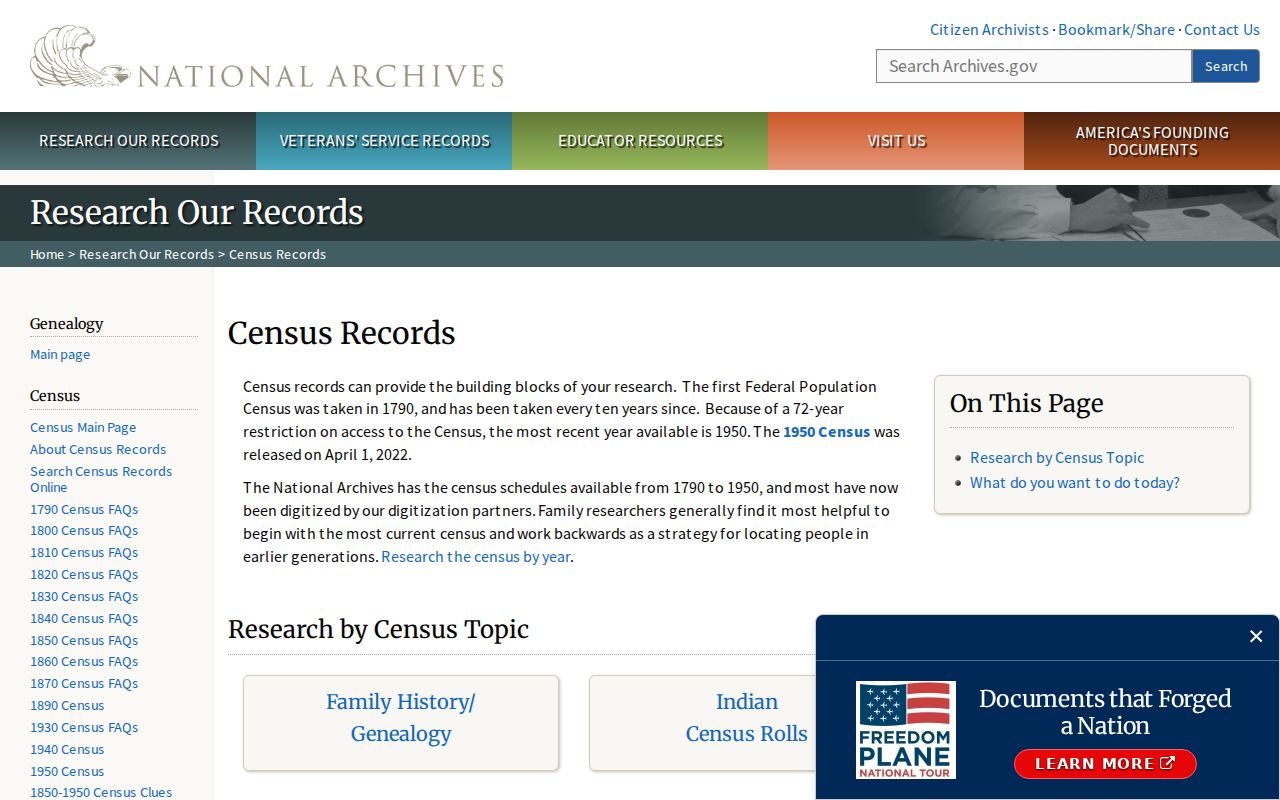
A good pairing looks like this: bracket the household in nearby directory editions, identify the matching census schedule, then return to the deed or permit record for the property timeline. Directory omissions can reflect an unlisted number, nonpublication, coverage boundaries, or an omitted household member.
Note: A census household is a dated observation, while a deed transfer is a dated title event; neither should be silently treated as a move-in date.
San Fernando Probate Records for Heirs
Probate, obituary, and death-index work can be a humane way to reconnect an heir with an estate. LAPL's California Death Index resources cover 1905 through 1994. A probate docket can point to an estate representative or heir, but the filed petition or order should be read before any conclusion is drawn. An old service address is a historical lead, not a current contact claim.
Start with the address and title sequence. Identify a former owner, search the relevant court probate index, and then request or inspect the public file under clerk rules. Pair the result with an obituary or cemetery lead, then use current official contact channels. The purpose is to clarify an estate or family history, not to expose household details.
Mission and church materials can add earlier context. San Fernando Rey baptism registers are documented for 1797 through 1855, but the verified inventory does not establish a public online name index or unrestricted copying. Pair church records with later civil, census, directory, or deed evidence carefully.
San Fernando Address Records Across Eras
San Fernando's geography changes the way previous residents are found. The city grew near Mission San Fernando Rey, the 1874 railroad and subdivision town, and citrus packing activity that expanded into the 1920s. It incorporated separately in 1911 and did not join the 1915 Los Angeles annexations. Those facts explain why a county deed, a Valley directory, a local city record, and a postal line can describe the same area with different custodians.
San Fernando Library opened in 1914, moved through North Maclay storefronts and First Street, and entered the civic center in 1953. LAPL's regional directories and the local history collections fill gaps between county records. Sanborn maps can show building footprint, use, and street continuity, but the actual San Fernando sheet years must be selected in the subscription database.
The local-history narrative documents López Adobe at Maclay and Pico as the oldest standing city building and identifies 1337 Coronel Street as a historical Ritchie Valens address. These details can anchor an ethical house-history example. They do not identify current occupants, and a historic address should not be used as a present whereabouts claim.
Lawful San Fernando Previous Residents
Previous residents research is strongest when it preserves the difference between title, occupancy, and historical context. Record the source, edition or instrument date, page, AIN, party role, and uncertainty. Stop when a protected address, sealed file, or unsupported present-day inference would be required.
Lawful use. San Fernando previous-residents research is appropriate for house history, genealogy, estate work, and personal curiosity. Do not use records to stalk, harass, threaten, or harm any person.
A careful trail can still be rich: current parcel, recorder deed, prior title parties, directories, census pages, death and probate leads, Sanborn sheets, and local history. Each source remains in its own lane. That is what makes a past-residents account useful without pretending that any one record is a complete list of who lived there.