
Start a San Fernando Resident Search
A name, an address, and a past year lead to different parts of the San Fernando residents directory. The Los Angeles County Assessor can locate a parcel by street address or Assessor Identification Number, but its public website suppresses owner names. The Registrar-Recorder/County Clerk keeps deeds and other recorded instruments, yet its real-estate index is searched in person by party name and recording year. The California Secretary of State provides personal voter status, not an open street list. Historical names come from city, telephone, census, newspaper, and local-history collections.
That split is useful when the purpose is clear. A property question starts with an AIN and legal description. A family-history question may start with an old street and move into a directory shelf. A probate or heir question belongs with the court index and the filed case. A city contract, permit, or ordinance belongs with San Fernando's City Clerk or the department that made the record. No one source proves who occupies a home, and a directory omission can reflect an unlisted number, an unprinted year, or a boundary problem.
- Confirm that the address is inside the incorporated City of San Fernando, rather than only using a postal city name.
- Use the Assessor Property Search or map to capture the AIN, situs, tract, lot, and other stable parcel clues.
- Choose the matching official roll: a deed index for title parties, a court index for a case, a vital-record channel for an event, or VoterStatus for your own registration.
- Check LAPL, the Library of Congress, FamilySearch, or the local-history shelf when the question reaches into an earlier household.
- Ask the custodian for a defined existing record under the California Public Records Act when no usable online route exists.
The Offices Behind San Fernando Resident Records
San Fernando's resident records cross three administrative levels. The city keeps its own legislative, permit, business, police, and public-request records. Los Angeles County handles the assessor roll, recorded property instruments, county vital copies, elections, and the court district serving the city. California supplies statewide vital guidance, professional licenses, business filings, and a personal voter-status lookup. The office matters as much as the name.
Los Angeles County RR/CC
12400 Imperial Highway
Norwalk, CA 90650
(800) 815-2666
Los Angeles County Assessor
Property Search and parcel map
Address or AIN inquiry
Owner names suppressed online
California Voter Records
Personal registration status
County file requests at Norwalk
(800) 815-2666
California VoterStatus
The county's San Fernando services directory points city residents toward the RR/CC, courthouse, library, and other county contacts. For a city-held record, the City Clerk's Online Records Counter is the better first stop. The right custodian keeps a request narrow and makes a search result easier to verify.
San Fernando City Records by Keyword
The City Clerk's Online Records Counter is a local name-and-address trail. Its visible search instruction calls for keywords such as a date, ordinance, resolution, or address. Those terms can surface names in minutes, contracts, claims, commission material, or address-keyed municipal records. City Hall is at 117 Macneil Street; City Clerk Julia Fritz can be reached at (818) 898-1204 or CityClerk@SanFernando.gov.
The counter is free to search, with email as the fallback when a keyword search misses the needed series. A request should identify the existing record, a date span, an address or document number, and the public fields sought. San Fernando says it has ten calendar days to decide whether responsive records are disclosable, then produces them in a reasonable time. The current legal citation is the California Public Records Act, Government Code §§7920.000-7931.000, even though the city page still uses the older section numbering.
| Search / keyword | Text entry; the city suggests a date, ordinance, resolution, address, or another useful term. |
|---|---|
| Search Online Public Records | Button or link that opens the indexed records counter. |
| Email fallback | CityClerk@SanFernando.gov; the request should name an existing record series rather than ask staff to build a dossier. |
San Fernando's public-records request instructions are especially useful for a narrow address search. Duplication charges under the current fee resolution are paid before production, and exempt details may be withheld or redacted.
San Fernando Assessor Records and Residents
The Assessor Property Search is the best parcel key in the San Fernando residents directory, not a household roster. Search by a normalized address or a ten-digit AIN, then note the situs, legal description, tract or lot, property type, values, building facts, and transfer-event clues that the public display provides. Owner identity and a private mailing address are not shown on the public website. A parcel record proves an assessment attached to land; it does not prove who sleeps there.
The map viewer adds geography. It can help a researcher click an adjoining parcel, compare AINs, and carry a stable legal description into a deed request. The county's event tabs may show recording date, sequence, document number or type, reassessment status, and sale-price information derived from documentary transfer tax. Those rows are leads. A recorded deed remains the source for grantor, grantee, legal description, and the relationship between a title event and a person.
| AIN | Assessor Identification Number, displayed as a four-three-three parcel key such as 1234-567-890. |
|---|---|
| Situs address | The physical location assessed; it is not automatically an owner's mailing address. |
| Parcel history | Effective-dated assessment, ownership-change, and roll entries that need a recorded instrument before they are treated as proof of a transfer. |
| Occupancy | Not established by an assessor card, exemption flag, tax payment, deed, or mailing field alone. |
The Los Angeles County Assessor portal is free to use. When a name is needed, the lawful path is a specific-property inquiry, a district-office channel, or the recorded-document trail.
The county services view below places the assessor, recorder, and other contacts in the local public-records landscape. It is a starting map, not a substitute for checking the named custodian.
San Fernando's county-services page helps separate city contacts from county record keepers.
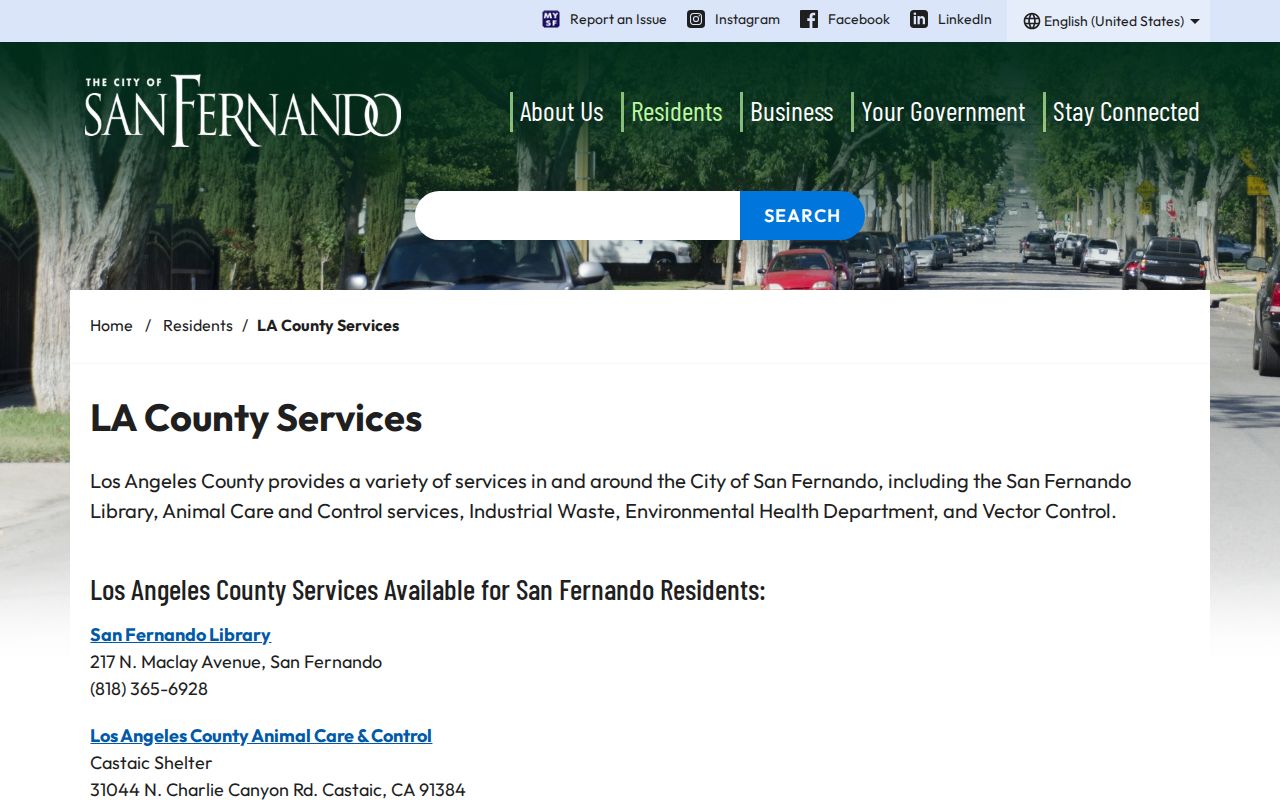
The county-services reference reinforces the jurisdiction split that keeps a San Fernando name search from drifting into the larger San Fernando Valley.
Current Sources for San Fernando Residents
Current resident evidence is a set of narrow records, each with a different keeper and limit. The table below separates title clues, court activity, public business roles, and a personal voter check. A source belongs in the search only when its fields answer the question at hand.
| Source | What It Can Lead To | Keeper | Access |
|---|---|---|---|
| Assessor parcel roll | AIN, situs, legal description, characteristics, event clues | Los Angeles County Assessor | Free address or AIN search; owner names omitted online |
| Recorded real-estate index | Grantors, grantees, deeds, liens, reconveyances, maps | Los Angeles County RR/CC | In-person name/year index; copies online, by mail, or at the counter |
| Case index | Party or defendant, case number, filing date, courthouse, public images | Los Angeles Superior Court | Online name search or courthouse terminal; fees and limits vary |
| VoterStatus | One person's registration or ballot-status result | California Secretary of State | Free personal identity check; voter-file requests are regulated |
| Business or license index | Entity, agent, public address, license status, discipline documents | California SOS or DCA | Free public searches; ownership is not maintained in bizfile |
| Unclaimed-property search | Name, reported city, and reporting business as a historical lead | California State Controller | Free search and claim start; not proof of present residence |
A property lead becomes a person lead only after the parcel, document, date, and role agree. For a single-name task, the San Fernando resident lookup workflow keeps those checks in a sensible order. For a street, the address-keyed chain belongs on the street directory page.
San Fernando Voter Records Stay Personal
California VoterStatus asks for first name, last name, date of birth, house number, and ZIP Code, with an election selection where ballot status is relevant. It is a personal registration lookup. A match can report registration or ballot status, but it never reveals a ballot choice. A county registration-status route is another official channel for a person checking their own record.
Election Code §2194 keeps voter-affidavit information away from casual browsing. The statute limits personal, private, commercial, marketing, harassment, and unauthorized internet-display uses, with added protection for identification numbers and other sensitive fields. Qualified file requests go through the Los Angeles County Election Information Section in Norwalk and carry the county's stated per-name or file fees. A voter result can support a permitted civic or family-history task; it cannot be turned into a public list of San Fernando households.
The official California VoterStatus form shows why identity fields are part of the process. Keep registration evidence separate from parcel evidence, and do not call a ballot-status result proof of occupancy.
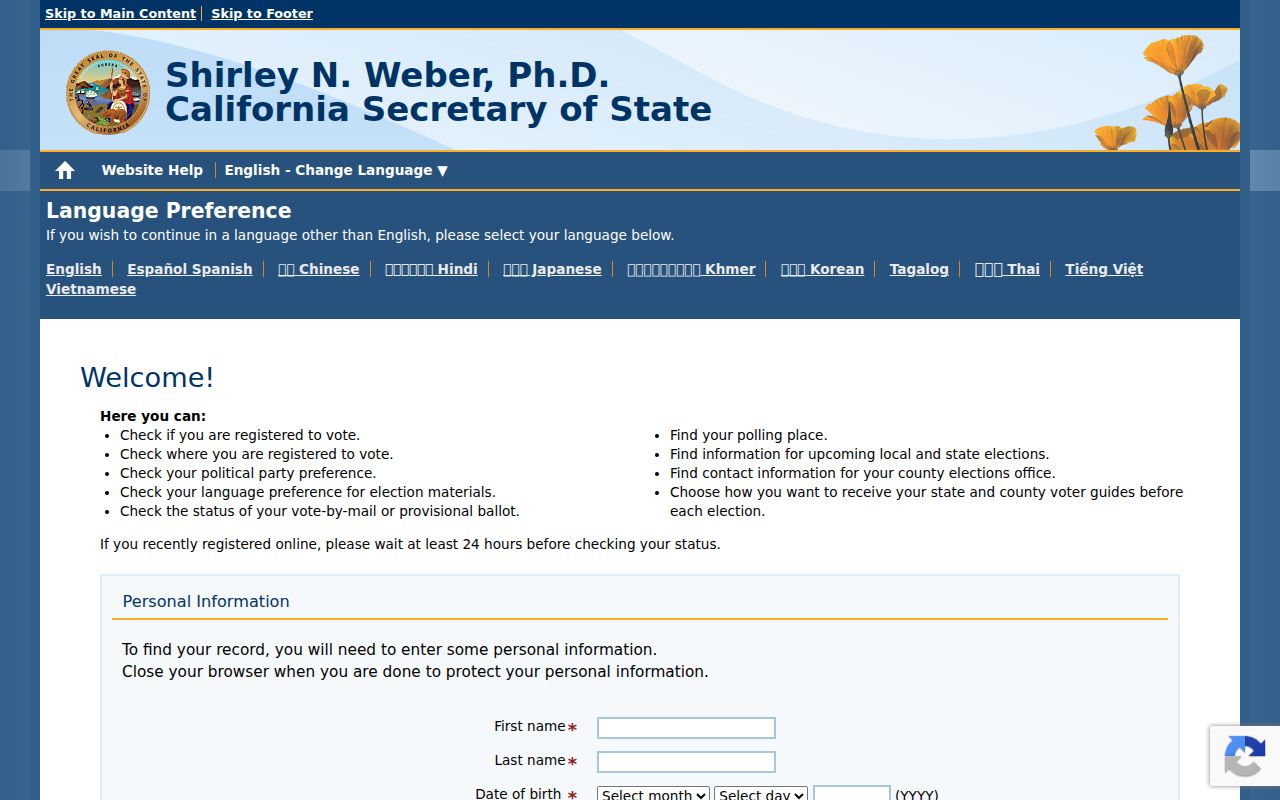
The voter-status screen illustrates a personal check, not a street browser. The distinction matters when a San Fernando address has more than one record custodian.
San Fernando's Directory Shelf Since 1875
The historical side of the San Fernando residents directory is unusually broad but not continuous. LAPL's digitized Los Angeles-area city and street-address directories span 1875-1987, with edition-by-edition coverage that must be checked for San Fernando. The Library of Congress has exact San Fernando telephone-directory items for December 1937 through August 1948, March 1967, May 1980, May 1984, May 1985, and May 1987 through April 1988. The isolated dates are verified holdings, not proof that every year exists.
FamilySearch catalogs a Los Angeles Directory Co. San Fernando Valley volume with private citizens, business firms, and rural residents across several Valley communities. LAPL's History & Genealogy Department also holds city-directory microfilm, paper volumes, census microfilm, California death and marriage indexes, and Sanborn maps. Each shelf answers a different question. A telephone listing supplies a listed subscriber and number, while a city directory may add occupation, spouse notation, or a street-order section.
San Fernando Library opened in 1914 as the first public library in the primarily agricultural Valley and moved through North Maclay storefronts before reaching the civic center. The branch is a useful local-history contact even when the main directory runs sit at LAPL Central. The complete collection map belongs in the San Fernando city directory treatment.
Older San Fernando Directories and Residents
A printed directory year can anchor a person to a street, a listed phone, or a business role at publication time. It cannot show every member of a household, and a missing entry does not prove that a person was absent. Unlisted numbers, a skipped edition, a different postal boundary, OCR errors, or a move between the Valley and the incorporated city can all create a gap.
For family history, save the title, edition date, image or page number, and the exact spelling before moving to deeds, voter registers, census schedules, obituaries, or newspapers. Pairing a directory entry with a released census schedule can add household composition, but the two records were created for different purposes. The city directory page explains the collection years and the reading method without turning an old listing into a present-day identity claim.
San Fernando ZIP Records Need Boundaries
The postal name “San Fernando” is wider than the incorporated city. ZIP 91340 is the primary postal area, while 91341 is used for a PO-box context and nearby addresses may show San Fernando in the mailing line while sitting in Los Angeles city territory. ZIP 91342 reaches Sylmar, 91345 reaches Mission Hills, and 91331 reaches Pacoima. A USPS result standardizes delivery; it does not decide municipal jurisdiction.
Use the Assessor situs, AIN, city boundary, and legal description together. The official parcel examples include an address using San Fernando and 91340 whose legal city is CITY-LOS ANGELES. Census ZCTAs are statistical approximations, not city limits. This is the geography reason a San Fernando residents directory search needs a parcel check before a record is described as a city record.
The San Fernando Post Office record is useful for the postal side of the comparison. The city boundary must come from the parcel and municipal sources.
San Fernando Vital Records: Leads and Copies
California vital records are not a simple public name index that opens after a fixed number of years. Authorized certified copies are limited to listed eligible people and uses, while informational copies can be available to any interested person and are marked “INFORMATIONAL, NOT A VALID DOCUMENT TO ESTABLISH IDENTITY.” Health and Safety Code §§103526 and 103526.5 shape the authorized-copy boundary.
Los Angeles County RR/CC is usually the practical channel for a birth, death, or marriage recorded in the county. CDPH supplies statewide instructions and mail applications. The 2026 CDPH fee research lists $31 for birth, $26 for death, and $19 for public marriage copies; a no-record search keeps the fee and may produce a Certificate of No Public Record. Divorce judgments come from the Superior Court, not a CDPH dissolution certificate. Adoption and confidential sections remain restricted.
The California vital-records office explains the statewide ordering path. A certificate can prove an event or relationship under its access rules, but it should not be treated as a current-residence record.
San Fernando Court Records and Probate
The North Valley District, San Fernando Courthouse at 900 Third Street, serves the city's Superior Court cases. The civil name index covers unlimited civil, probate, and family matters from 1983 to the present, limited civil from 1991, and small claims from 1992. The criminal index covers felonies from 1980 and misdemeanors from 1988, with some older automated municipal-court material. Traffic and infractions are excluded from the criminal defendant index.
Search fields include last name, first name, company name, search type, and guest or registered access. A result can show a party or defendant, case number, case type, filing date, location, and the number of available images. A paid search may be charged even when it returns no match. The portal is an index, not the official file. Public courthouse computers, the clerk file, certified copies, and Archives are the fallback when a result needs proof or an older case.
Probate can provide an estate representative or heir lead. Read the filed petition and order, preserve the case role, and avoid treating an old service address as a current whereabouts claim. The Los Angeles Superior Court case-search entry is the correct starting gate.
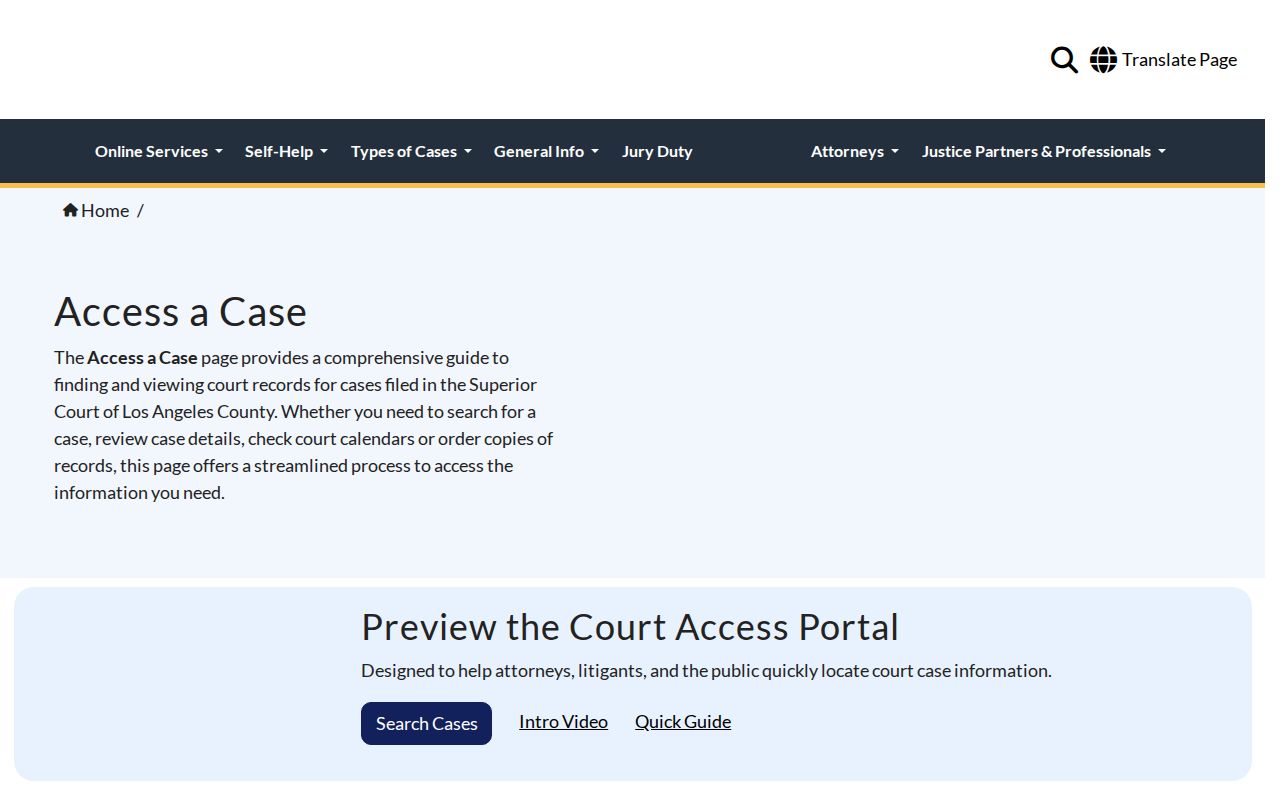
The court-search view shows a name index with defined fields. Any important result should be checked against the clerk's public file and its access limits.
San Fernando Business and License Records
Some San Fernando names appear in a public role rather than a household roll. California Secretary of State bizfile Online can return an entity name and number, formation or registration date, status, jurisdiction, agent, street or mailing address, statement due date, and filing PDFs. It does not maintain ownership, phone, email, subsidiaries, or associated businesses. A Los Angeles County fictitious-business-name record may add a county-level trade-name lead.
The Department of Consumer Affairs search covers a person's or business's license number, license type, status, issue and expiration dates, public address, and discipline documents. Board-specific systems still matter for some professions. These sources can confirm a public business connection or license history. They do not prove a private home address or present residence.
The California license search and bizfile Online are free starting points. A result belongs in the San Fernando residents directory only as a labeled public-role clue, with its date and record type intact.
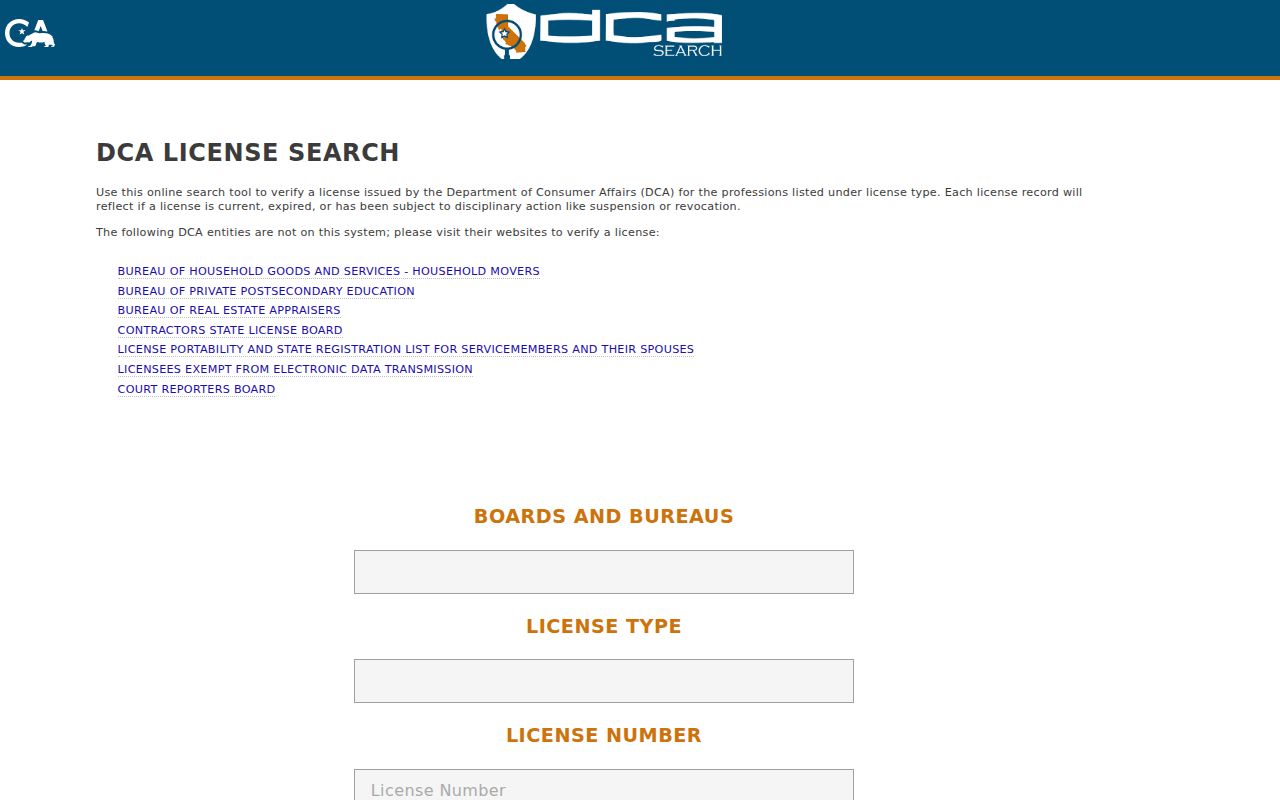
The license form makes the record's public role clear. It should be cross-checked with city business-license or county fictitious-business-name material when the question concerns a local enterprise.
Safe Uses of San Fernando Resident Records
Resident records work best for family history, reconnecting with a classmate or military friend, tracing an estate, checking a seller's public business role, understanding a neighborhood, or following a civic record. The record keeper's purpose limits still apply. Public does not mean complete, current, or free to republish without care.
California's Safe at Home program can provide a substitute mailing address, forwarding, a process agent, and confidential voter registration for qualifying people facing domestic violence, stalking, sexual assault, child abduction, elder or dependent-adult abuse, trafficking, or specified threats. The program does not erase a legal description. California privacy rights and the 2026 DROP data-broker process address commercial data practices, not the county's underlying public records.
Verify a high-stakes fact with the office that created it. A copied listing can be stale; a correction belongs with the assessor, recorder, court, election office, or other custodian.
San Fernando Record Systems Compared
San Fernando covers 2.37 land square miles and sits inside a much larger metropolitan record geography. Census QuickFacts reports 23,946 people in 2020 and a density of 10,086.8 people per square mile. Current estimates also describe a city where Spanish-language sources, compound surnames, accents, and local history matter to search quality. Keep surname parts separate, retry legacy OCR without diacritics, and test married or birth forms without assuming any one form belongs to a person.
The record trail follows the city's history. Mission registers reach back to the 1797 San Fernando Rey foundation, county deeds and rancho records follow land, railroad and subdivision material follows the 1874 town, municipal files begin with incorporation in 1911, and digital parcel, permit, court, and directory tools handle the modern layer. The 1971 Sylmar earthquake and 1994 Northridge earthquake are historical context, not proof that a county record series was lost.
- Roll
- An official list of assessed or registered entries, such as the county property roll, with fields and access limits set by its custodian.
- Index
- A finding aid for a record set. It can point to a case, deed, or filing without being the complete document image.
- Criss-cross directory
- A street- or address-order directory that moves from a place to a listed name in a particular edition.
- Parcel
- A mapped unit of land identified by an AIN, situs, and legal description; it is not the same as a household.
That is the practical meaning of a San Fernando residents directory: a careful path through city, county, state, library, archive, and court sources. Preserve the jurisdiction, record date, source URL, and evidence limit at each step. When a result cannot establish residence, label it as a parcel, title, public-role, historical, or case clue instead of stretching it into a roster.
The California State Controller's unclaimed-property search is one more example of a useful but narrow name-and-location lead. It reports property to a city, not a current home.
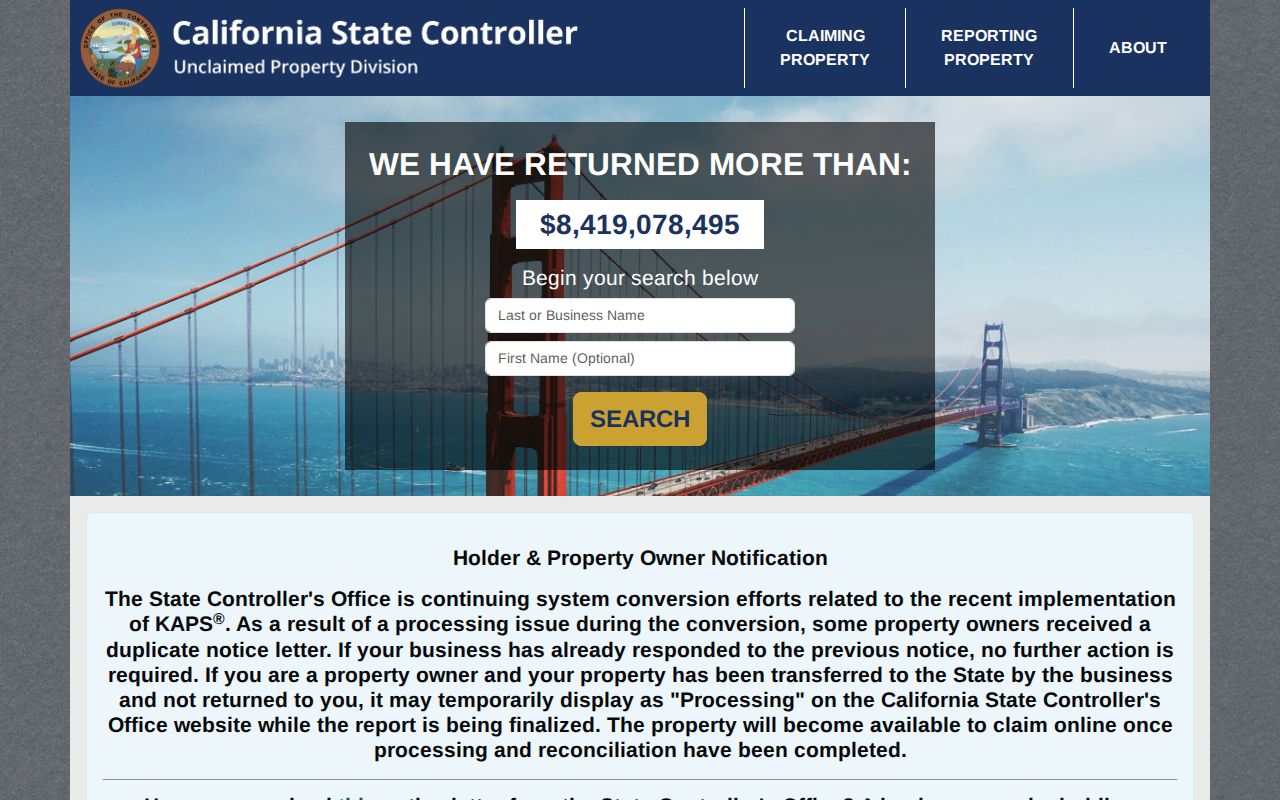
The unclaimed-property screen closes the loop: even a free state search needs a clear label, a date, and a check with the source before it is treated as evidence.